Opening a restaurant begins with a culinary vision, but survival ultimately comes down to spatial logistics. You can have the most innovative menu in your city, but if your expediter is constantly colliding with servers at the kitchen double doors, service will break down.
Most people think floor plans are about tables. In practice, it’s about whether two people can pass each other without spilling a tray of hot soup. Your layout dictates the exact path hot food takes to the dining room, the route dirty dishes take to the dish pit, and how efficiently you can turn tables during a Friday night rush.
The Balancing Act of Restaurant Logistics
Finding the perfect spatial balance is notoriously difficult, particularly for first-time operators. You need to maximize seating capacity to hit your daily revenue targets, but over-stuffing the dining room ruins the guest experience and creates fire hazards.
Furthermore, operators often make the fatal mistake of prioritizing the Front of House (FOH) at the expense of the Back of House (BOH). As a general industry standard, a functional restaurant requires a 60/40 split: 60% of your square footage dedicated to the dining and bar areas, and 40% reserved for the kitchen, storage, and prep areas. If you skimp on the kitchen footprint to squeeze in two extra four-tops, your ticket times will drag the minute the board fills up.
When mapping out your space, you must account for rigid, real-world metrics, including:
- Aisle Clearances: You need a minimum of 36 inches between tables to meet ADA compliance and allow staff to navigate safely with trays.
- Square Footage per Diner: A fine dining concept requires roughly 18 to 20 square feet per person, while casual dining can operate comfortably at 15 square feet per person.
- Server Stations: Placing point-of-sale (POS) terminals and water stations strategically prevents bottlenecks and keeps servers on the floor.
The High Cost of Traditional CAD Software
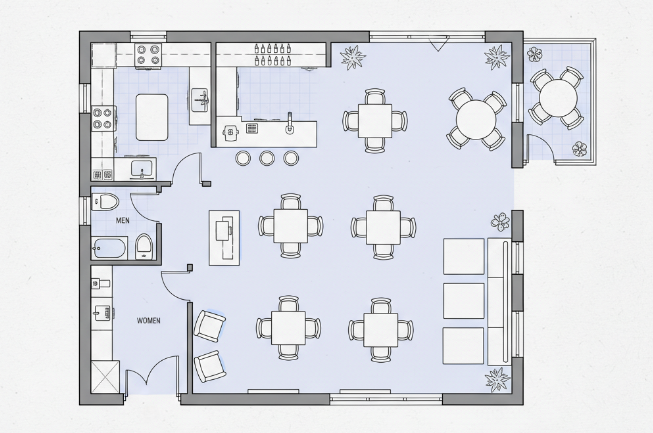
Historically, solving these spatial puzzles required hiring an architect or interior designer on day one. Drafts were typically built in expensive, complex software like AutoCAD, Revit, or SketchUp.
For independent hospitality groups, this traditional method presents two massive roadblocks: cost and time. Spending thousands of dollars out of your startup budget just to see a basic initial draft is a heavy burden. Worse, if the bar needs to be shifted six feet to the left to accommodate plumbing, you have to wait days for the designer to send back revisions.
When you are actively trying to pitch investors, secure a Small Business Administration (SBA) loan, or determine if a commercial lease actually fits your concept, waiting two weeks for a layout simply isn’t viable.
What AI Floor Plan Generators Can Do
Because speed and flexibility are crucial in the early stages of restaurant development, modern operators are bypassing traditional drafting in favor of AI-driven design tools.
That means:
- fewer redesign costs
- faster investor validation
- clearer lease decisions
- better contractor communication
You no longer need a degree in architecture to establish your initial spatial flow. Today’s AI restaurant floor plan generators allow you to instantly build a working, mathematically accurate schematic. By inputting a few basic requirements into the software, the AI configures a functional layout in seconds.
Key inputs usually include:
- Total square footage and structural boundaries.
- Desired service style (e.g., fast-casual, cafe, or fine dining).
- Target seat counts and FOH/BOH ratios.
A clean schematic doesn’t just help you build the restaurant, it helps you avoid building the wrong one.
The Freedom to Experiment
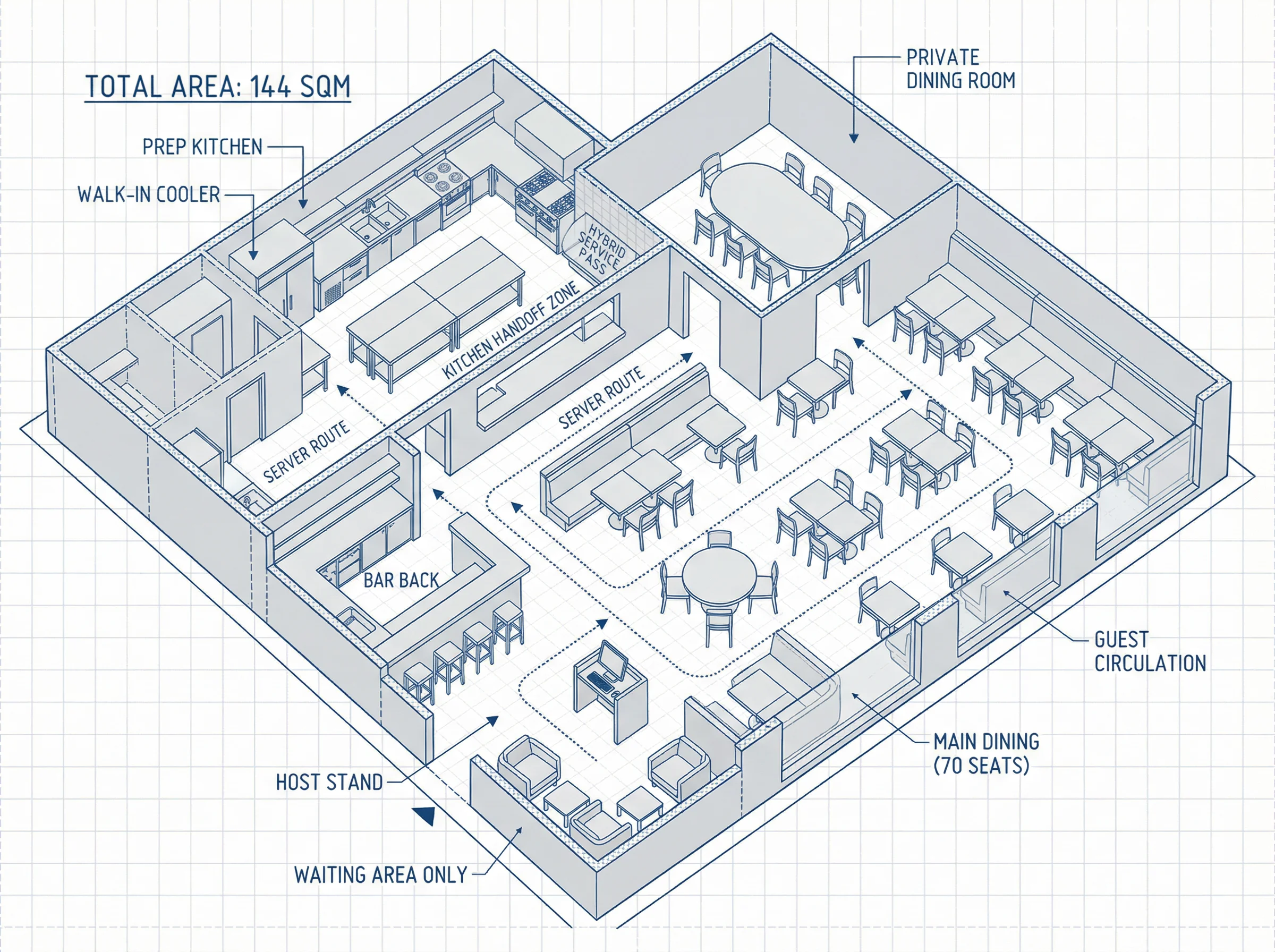
Using AI gives hospitality operators the immediate freedom to A/B test their space. You can instantly visualize how the room flows with a heavy emphasis on profitable two-tops versus large communal booths. You can test different bar placements, adjust the width of the kitchen line, and verify that your server paths are unobstructed.
Ready to visualize your space?
Stop waiting on expensive designers and endless revisions. Try AIAI.com’s restaurant floor plan tool today to generate your first professional restaurant floor plan in seconds.

Introduction: Bring Your Memories to Life on Your Fridge Your refrigerator is more than just a container for chilled food—it's Read more

Stuck on your next build? Use the best Minecraft AI Generator to design custom skins from photos, visualize epic builds, Read more

Quickly create professional book covers with an AI book cover generator like AIAI, no design skills needed.

If you’ve ever opened a video editor and felt stuck, AI video generators might feel like a shortcut worth trying. Read more