A Beginner’s Guide to GPT-5.2: What Non-Technical Users Should Know
The wait is over. On December 11, just weeks after Google shook the industry with Gemini 3, OpenAI officially released GPT-5.2.
It feels like we just got settled with GPT-5.1, doesn’t it? But the AI world moves fast. However, unlike previous updates that just chased “faster and smarter,” GPT-5.2 changes the fundamental way we interact with AI. It’s no longer just a chatbot; it’s an Agent.
The “Code Red” Release
The rapid release appears to be the result of an internal “Code Red” at OpenAI, triggered directly by the dominance of Google’s Gemini 3 in November.
Unlike previous “flashy” updates, GPT-5.2 is an architectural refinement focused on one thing: Agentic Reliability. It is designed not just to “chat,” but to work autonomously for hours without getting confused.
This isn’t just a patch. While GPT-5.1 was a “warmth and personality” update, GPT-5.2 is designed to focus on Agentic Reliability. Meaning it can perform long, multi-step tasks like coding an entire app or analyzing massive spreadsheets without getting confused.
The “Three-Model” Strategy: Why This Feels Different
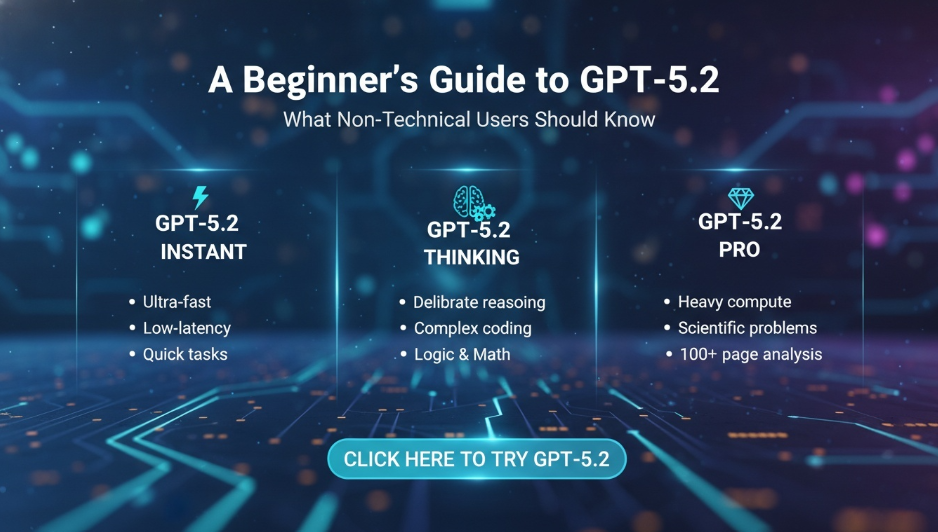
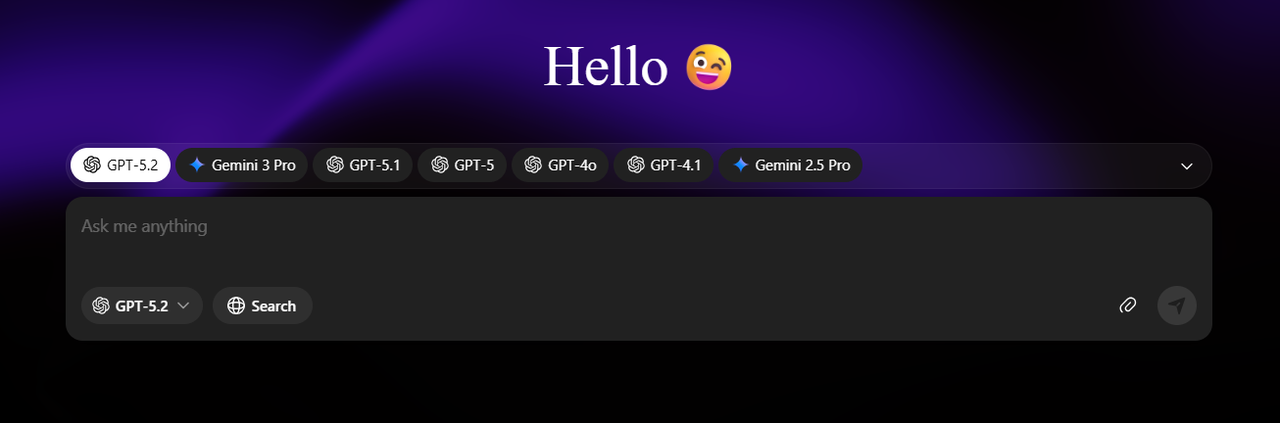
Responding to the diverse needs of users, OpenAI has split GPT-5.2 into three distinct behaviors, You will see these in your model selector:
- GPT-5.2 Instant: It is ultra-fast, low-latency, and designed for everyday tasks, emails, and quick clarifications. It replaces the standard GPT-4o/5-mini experience.
- GPT-5.2 Thinking: The default for complex work. This model deliberately pauses to think (using Chain-of-Thought reasoning) before answering. It is slower, but significantly smarter at math, coding, and logic.
- GPT-5.2 Pro: The heavy lifter for the most complex, high-compute queries. Available to Pro and Enterprise users, this model has a massive compute budget for solving deep scientific problems or analyzing 100+ page documents without error.
(Don’t want to read the specs? 【Click Here to Try Gpt 5.2】right now and see for yourself
New Features: What You’ll Actually Notice
Smarter, More Reliable Reasoning
GPT-5.2 shows substantial gains in multi-step reasoning and complex task handling versus GPT-5.1.
What this means for you:
- Better handling of multi-step logic tasks
- Fewer internal contradictions
- More consistent answers across long workflows
Agentic Workflows (The Big Deal)
This is the headline feature. In older models, you had to babysit the AI (“Write the outline,” then “Write chapter 1,” then “Fix the tone”).
GPT-5.2 is designed to act as an Agent.
You can give it a high-level goal, something like “plan a 3-day marketing campaign and draft all the copy“, and it will autonomously break that down into steps, execute them, and present the final package.
Reduced Hallucinations
OpenAI reports a 30% reduction in errors compared to GPT-5.1. While it’s not perfect, the “Thinking” model is much less prone to making up facts because it “sanity checks” its own answers before showing them to you.
Context Compaction
I just call it better memory, but the official term is Context Compaction.
The Problem: Old models would “forget” the beginning of a conversation if it got too long.
The Fix: GPT-5.2 can handle 400,000 tokens of information (roughly a Harry Potter book) with near-perfect recall. It actively “summarizes” older parts of your chat in the background so it never loses the thread of a long project.
Expert-Level Professional Work
OpenAI introduced a new benchmark called GDPval, measuring proficiency across 44 distinct occupations. GPT-5.2 Thinking performs at or above a human expert level in many of these, specifically in technical writing, strategy, and coding.
Coding Dominance
With the subsequent release of GPT-5.2-Codex, the model has reclaimed the throne from competitors in software engineering, capable of refactoring entire files rather than just small snippets.
GPT-5.2 vs. GPT-5.1: The Breakdown
| Feature | GPT-5.1 | GPT-5.2 (Thinking) |
| Response Style | Immediate, stream-of-consciousness | Pauses to reason, then answers |
| Complex Tasks | Often lost focus on long tasks | Maintains context for multi-step projects |
| Coding | Good at snippets | Good at full-system architecture |
| Reliability | Prone to confident errors | significantly lower hallucination rate |
While the core user experience remains familiar, GPT-5.2 feels more polished and usable across professional and creative tasks.
Model Comparisons: Who Wins?
| Feature | OpenAI GPT-5.2 | Google Gemini 3 | Claude Opus 4.5 |
| Reasoning & Logic | 👑 Winner (Thinking Model) | Strong | Strong |
| Coding | 👑 Winner (Tied with Opus) | Good | Excellent |
| Video & Audio | ❌ Basic (Frame-based) | 👑 Winner (Native) | Basic |
| Speed | 👑 Winner (Instant Model) | Fast | Slower/Deliberate |
| Context Window | 400k Tokens | 1 Million+ Tokens | 200k Tokens |
The Elephant in the Room: What It Still Can’t Do
Let’s be real, the current AI is still not the movie Her yet:
- It still lies (sometimes): Hallucinations are reduced, not eliminated. You still need to fact-check it.
- Real-time info: Unless it’s browsing the web, its internal knowledge is still cut off at its training date.
- Video: While rumors swirled about video analysis, this update remains focused on text and images.
- Speed vs. Smarts: You now have to choose. If you want the smartest answer (Thinking model), you have to wait a few seconds. Instant answers are less intelligent.
GPT-5.2 Frequently Asked Questions
Is GPT-5.2 better than GPT-5.1?
Yes. It shows clearer upgrades in reasoning, context awareness, speed, and multimodal handling. OpenAI
Does GPT-5.2 do advanced video reasoning?
Not generally available yet; current capabilities focus on images and documents.
Is GPT-5.2 “smarter” than Google Gemini 3?
Comparisons depend on the task and benchmark, and OpenAI doesn’t officially claim universal superiority. Public competition claims vary by use case.
Why is the “Thinking” model slower?
It’s a feature, not a bug. It is literally “thinking” (running internal monologues to check its logic) before it types a single word to ensure accuracy.
Will GPT-5.2 support video or advanced multimodal features?
Rumored, but unfortunately no
Is GPT-5.2 smarter than Google Gemini 3?
It’s a close call. It really depends on your work type at this point.
[> Test both here to see which fits your workflow.]
Conclusion
GPT-5.2 turns the “AI Wars” into dead heat once again. The real winner isn’t OpenAI or Google, it’s the users who get access to increasingly powerful tools every few weeks.
Have you tested the new model yet? [Click here to generate your first GPT-5.2 response] and let us know if you like it.

Don’t let your memories fade away. Use AI photo restoration to restore faded, blurry, or damaged pictures online. See your Read more
Learn how to use an AI-powered Veo Watermark Remover to delete Google Veo video watermarks online quickly and create clean, Read more
Still wasting hours manually aligning grey boxes in Figma before writing a single line of copy? Discover how generative AI Read more

This hands-on review takes a closer look at Vidu Q3, the latest AI video generation model, focusing on real-world performance Read more